Planning
MDF marketing: a request template for channel partners, from approval to claim
How MDF marketing works for MSPs and resellers: a fill-in request template, a worked example, a claim pack checklist and the dates that decide payment.
Will Undrell15 min read
Share
MDF marketing is marketing that a vendor pays for, in part or in full, from its market development funds: you run the activity, then claim the agreed share back with proof. To get paid, request one activity that leads with the vendor's priority and pipeline, and build the claim pack while the campaign runs. Below are a fill-in request template, a filled-in example, a claim pack checklist and the dates from two real programmes.
MDF goes unclaimed when partners treat the request and the claim as separate jobs. Extu's 2026 piece on rethinking market development funds cites Forrester saying MDF makes up nearly half of the average supplier's channel marketing budget. It also says 60% of allocated MDF goes unused each quarter, and links that figure to a LinkedIn article by Jay McBain, not to Forrester. Some of the loss happens after the work is done: the campaign runs, and the receipts are still scattered across inboxes when the claim window closes.
Picture an MSP that runs a well-attended webinar in March and starts the claim in June. The vendor asks for the attendee list, the invoices and copies of the promotion emails, and the programme's claim window closed weeks earlier. The work happened and the leads are real, but the money stays with the vendor.
Write your request around a campaign you'd run anyway. A request invented to use up the fund reads that way, and the vendor can tell. Then lead with what the vendor gets. Vendors fund their own targets, so the request should talk about pipeline on their product and named accounts, not about your brand.
Every programme differs. We use MobileDemand and Pega below because both publish their full MDF rules on the open web. MobileDemand asks for 4 weeks' notice; Pega's 2022 guide releases half the approved amount on approval and half at agreed milestones, and you pay the costs first either way. Treat everything below as a starting point and check your own vendor's rules before you submit.
What will a vendor fund with MDF?
Vendors fund marketing activity that puts their product in front of buyers. They don't fund your running costs, and their exclusion lists are specific.
MobileDemand's MDF request form is a good example. It offers MDF only to Premier and Select partners, and it excludes alcohol, travel, hotel rooms, hospitality suites, telephone charges, reclaimable taxes such as VAT, and web hosting. If your event budget leans on drinks, travel and guest rooms, that part won't be covered. If you're VAT-registered, put costs in the request net of VAT, because you can't claim the tax back from the vendor as well as from HMRC.
Keep to one activity per request. MobileDemand asks for one form per activity, and Pega's January 2022 partner MDF guide allows one activity per claim. Bundling a webinar, paid ads and a direct mailer into one request makes the approval harder, because the reviewer has to judge three activities at once. It also makes the claim harder, because one missing invoice can hold up the payment for all three.
The vendor-side templates show what reviewers look for. xAmplify's MDF request form template lists activity type, objective, audience and reach, dates, total cost, MDF requested, match ratio (its example is 50/50), expected leads or pipeline, measurement, products promoted and approval fields, and it states "no proof, no payment". It's a useful field list, but it's written for the vendor running the programme (xAmplify sells a partner-management platform), and it doesn't include a filled-in partner request. Older partner advice, such as MSP Growth Hacks' 2020 post on requesting market development funds, focuses on events like lunch and learns, virtual expos and webinars, and doesn't cover claims, proof or deadlines. The template below covers the partner's side, from the request through to the claim.
The MDF request template
Copy this into a document, replace each square-bracket placeholder and delete anything your vendor's form doesn't ask for. If your vendor has its own form, use this as your working draft and transfer the answers across.
MDF REQUEST

1. Partner and plan owner
Partner company: [Company name]
Partner tier / programme level: [Tier]
Plan owner (named person responsible for delivery and claim): [Name, role, email, phone]
Vendor contact: [Channel account manager name]

2. Vendor priority supported
Vendor product or solution promoted: [Product name]
Vendor priority or campaign this supports: [e.g. vendor's quarterly focus, launch, or named programme]
Why this activity fits that priority: [One or two sentences]

3. Activity (one activity only)
Activity type: [e.g. webinar, event, email campaign]
Description: [What happens, in two or three sentences]
How it is promoted: [Channels used to drive attendance or response, as part of this activity]

4. Target accounts and audience
Audience: [Job roles and type of organisation]
Number of contacts reached: [Number]
Number of named target accounts: [Number]
Named accounts (attach list if needed): [Account names or "see attached"]
Existing customers or new prospects: [Split, with numbers]

5. Dates
Request submission date: [Date]
Activity start date: [Date]
Event or webinar date: [Date]
Activity finish date: [Date]
Claim-by date: [Date, from vendor's claim window]

6. Costs (net of reclaimable VAT)
[Cost line 1]: £[Amount]
[Cost line 2]: £[Amount]
[Cost line 3]: £[Amount]
Total activity cost: £[Amount]
MDF requested: £[Amount] ([Percentage]% of total)
Partner contribution: £[Amount] ([Percentage]% of total)

7. Expected vendor outcomes
Attendees or responses: [Number]
Meetings booked on vendor product: [Number]
Pipeline value on vendor product: £[Amount]
Expected timeframe for pipeline: [e.g. within 90 days of finish]

8. Reporting method and proof
How results are measured: [e.g. registration platform, CRM opportunity tags]
Proof of performance supplied with claim: [Invoices, screenshots, attendee list, lead list, other]
Results report date: [Date]

9. Follow-up plan for each lead
Within [number] days of the activity, each lead receives: [Action]
Owner of follow-up: [Name or team]
How opportunities are tracked against this activity: [Method]
A filled-in request: a webinar for existing clients
Here is the template filled in for a 40-person MSP in Leeds. Swap in your own vendor, numbers and dates.
The MSP wants a security vendor to fund a Q1 2027 webinar for its existing clients, promoted by email. That counts as one activity, because the emails only promote the webinar. Treating the emails as part of the webinar keeps the request to one activity and one claim.
MDF REQUEST

1. Partner and plan owner
Partner company: [Your MSP] (40-person MSP, Leeds)
Partner tier / programme level: [Your tier]
Plan owner: [Your marketing manager, contact details]
Vendor contact: [Vendor channel account manager]

2. Vendor priority supported
Vendor product or solution promoted: [Vendor's security product]
Vendor priority this supports: Q1 2027 push to move existing MSP clients onto [product]
Why this fits: Our clients already use Microsoft 365 but not [product]. A webinar for existing clients puts the product in front of decision makers who already trust us.

3. Activity (one activity only)
Activity type: Webinar
Description: A 45-minute webinar for our clients on [security topic], with a short demo of [product] and a Q&A.
How it is promoted: Three invitation emails and one reminder email to existing clients.

4. Target accounts and audience
Audience: Owners, finance directors and office managers at SMB clients
Number of contacts reached: 300
Number of named target accounts: 120 existing clients
Named accounts: See attached list
Existing customers or new prospects: 120 existing clients, 0 new prospects

5. Dates
Request submission date: 17 November 2026
Activity start date: 11 January 2027 (first invitation email)
Webinar date: Tuesday 9 February 2027
Activity finish date: 26 February 2027 (final follow-up email)
Claim-by date: [vendor's claim window applied to 26 February 2027]

6. Costs (net of VAT)
Email copy, design and build (4 emails): £800
Webinar platform licence (1 month): £400
Landing page and registration form: £300
Presenter preparation and slide design: £500
Total activity cost: £2,000
MDF requested: £1,000 (50% of total)
Partner contribution: £1,000 (50% of total)

7. Expected vendor outcomes
Registrations: 50
Attendees: 30
Meetings booked on [product]: 8
Pipeline value on [product]: £60,000
Expected timeframe for pipeline: within 90 days of finish

8. Reporting method and proof
How results are measured: Webinar platform registration and attendance data; CRM opportunities tagged "Q1 webinar"
Proof supplied with claim: Supplier invoices, email screenshots with send dates, landing page screenshot, webinar recording link, attendee list, lead list with meeting status
Results report date: 26 March 2027

9. Follow-up plan for each lead
Within 2 working days: every attendee gets the recording and a meeting invitation from their account manager; every no-show gets the recording.
Owner of follow-up: our account managers
Tracking: Each meeting and opportunity logged in CRM against the webinar tag, reported to the vendor at 30 and 90 days.
Look at what the example leads with. Section 2 names the vendor's priority and section 7 talks about meetings and pipeline on the vendor's product. The MSP's own brand barely appears, and that's deliberate.
Before you submit, read your request the way the vendor's reviewer will:
- Does section 2 name a priority the vendor has announced, in the vendor's own words?
- Is there only one activity, with everything else promoting it?
- Does every cost line have a supplier quote behind it, net of VAT?
- Do the outcomes in section 7 count meetings and pipeline on the vendor's product?
- Is the claim-by date in your calendar, with a reminder a week before?
If any answer is no, fix it before you send.
How do you get an MDF claim paid?
Build the claim pack while the campaign runs, because a claim can still fail after the work is done. You've spent your own money, run the campaign and booked the meetings, and then you can't produce the proof by the deadline. xAmplify's template puts the rule plainly: no proof, no payment.
Claim windows are short. MobileDemand wants claims within 30 days of the activity finishing, with receipts and proof of purchase, and pays as account credit within 30 days of claim approval. Pega's 2022 guide gives 60 days after the activity ends, requires one activity per claim and invoices in US dollars, and pays within 60 days. Pega also rejects anything that wasn't pre-approved, so a cost you added halfway through the campaign won't be paid.
Set up one folder per request on the day it's approved, and save each item as it happens: the invoice when it arrives, a dated screenshot of each email as it sends, and the attendee list on the afternoon of the webinar. Thirty days is enough to file a claim, but not to rebuild one from memory.
- [ ] Approval email or approval reference, with the approved amount
- [ ] Supplier invoices for every cost line, matching the approved items
- [ ] Proof of payment for each invoice
- [ ] Screenshots of each email, ad or page, with dates visible
- [ ] Event or webinar recording link, if there was one
- [ ] Registration and attendee lists exported from the platform
- [ ] Lead list showing each lead's follow-up status and meetings booked
- [ ] Pipeline report for the vendor's product, tagged to this activity
- [ ] Claim form completed and checked against the vendor's currency and format rules
- [ ] Claim submitted, with the date noted and a calendar reminder for payment
How long does MDF take, from request to payment?
This table puts the two example programmes side by side. MobileDemand's figures come from its MDF request form and Pega's from its January 2022 partner MDF guide, which is now a few years old. Fill in the last column from your own vendor's rules before you set any dates.
| Stage | MobileDemand | Pega (2022 guide) | Your vendor |
|---|---|---|---|
| Who can apply | Premier and Select partners only | Partners in good standing with a Pega distinction (Authorized, Specialized, Global Elite or Government Elite) | [ ] |
| Minimum return | Not stated | Plan must show at least 10:1 ROI | [ ] |
| Notice before activity | At least 4 weeks | Check the guide | [ ] |
| Vendor questions | Check the form | Answer within 7 business days or the request is rejected | [ ] |
| Vendor decision | Within 10 business days (approval, conditional approval or denial) | Within 10 business days | [ ] |
| Accept approved plan | Check the form | Within 5 days | [ ] |
| Start activity | Check the form | Within 30 days of approval | [ ] |
| When funds are released | After the claim, as account credit | 50% available to spend on approval, 50% when agreed milestones are met; you pay first and are reimbursed against proof; no funding for activity already run | [ ] |
| File claim | Within 30 days of activity finish, with receipts and proof of purchase | Within 60 days after activity ends, one activity per claim, invoices in US dollars | [ ] |
| Payment | Account credit within 30 days of claim approval | Within 60 days | [ ] |
Work backwards from your activity start date. With MobileDemand, a webinar on 1 March means the request goes in by 1 February at the latest, and earlier if you want room for a conditional approval.
Where Yori fits
Yori is an AI marketing assistant built for the IT channel. It draws on the marketing expertise of channel veterans with more than 25 years' experience. Its Campaign Proposal Service (listed as MDF requests on our Services page) drafts the case for approving and funding a campaign, which is what an MDF request is. Run it in a project with your Brand Profile and Audiences set. For the Brand Profile, Yori researches your website and any documents you add, and records what you sell, how you work and how you sound.
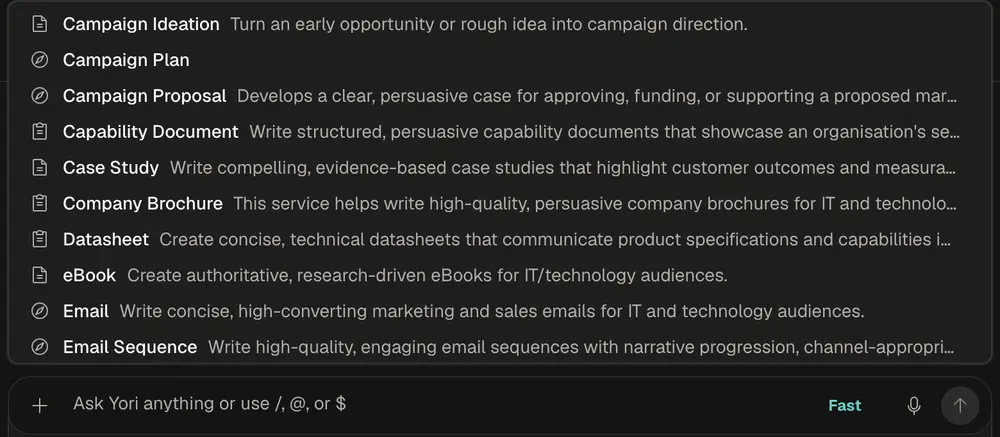
Campaign Proposal is the Guided Service for MDF requests. Type $ in the message box to pick it.
Upload your vendor's MDF rules PDF to the project so the draft follows them. Yori asks you questions, gathers the material it needs and drafts the proposal in Canvas, where you can edit it. It works from the rules you upload, so check the draft against the vendor's own form before you submit it. The proposal is saved in the project. Once it's approved, the Campaign Plan, Email Sequence and Marketing Budget Services build the campaign from the same context.
Every reply shows its credit use. Pricing (ex VAT): the free trial has 25 one-time credits, needs no card and expires after one month. Pro is £49 a month with 25 monthly credits. Extra credits cost £1 each. Business is £129 a month with the same 25 monthly credits, and adds shared Brand Profiles, Organisation Services and Workspace Rules. All plans have unlimited users, and annual billing is 10% less.
When your next MDF window opens, start the free trial, upload the programme's rules and run the Campaign Proposal Service on the campaign you were going to run anyway.
Frequently asked questions
What is MDF marketing?
MDF marketing is marketing that a vendor pays for, in part or in full, from its market development funds. The partner runs the activity, such as a webinar, an email campaign or an event, then claims the agreed share back with proof. Most programmes pay after the claim, so you pay the costs first.
How far ahead should I submit an MDF request?
Follow your vendor's notice period and leave time for questions. MobileDemand asks for at least 4 weeks' notice and replies within 10 business days. Pega's 2022 guide gives the same response time; if Pega asks a question, reply within 7 business days or the request is rejected.
What happens if I miss the claim deadline?
Treat the deadline as firm. MobileDemand allows 30 days after the activity finishes. Pega's 2022 guide allows 60 days and rejects later claims, leaving only a dispute through its support portal. If you expect a delay, speak to your vendor contact before the deadline.
Can I put a webinar and an email campaign in one request?
Only if the emails exist to promote the webinar, so the webinar is the single activity. MobileDemand asks for one form per activity and Pega allows one activity per claim. If the emails stand alone as their own campaign, or you're adding ads or a mailer, split them into separate requests so each can be approved and claimed on its own.
Will the vendor pay before the activity runs?
Plan on paying first. Pega's 2022 guide makes 50% of the approved amount available to spend on approval, but you pay the suppliers and Pega reimburses you against proof; the other 50% follows at agreed milestones. MobileDemand pays after the claim, as account credit within 30 days of claim approval. Budget your own cash for the whole campaign until the money lands.
Can I claim VAT on MDF costs?
Not with MobileDemand, which excludes reclaimable taxes such as VAT. If you're VAT-registered, put your costs in the request net of VAT so the numbers in the request match the claim. Check your own vendor's rules, and note that Pega's 2022 guide asks for invoices in US dollars.
Written by Will Undrell
Yori is built with the marketing expertise of channel veterans with more than 25 years in the IT channel.

Do it in Yori
Use the Campaign Proposal Service
Yori guides the brief, drafts it in your brand voice and saves it to your project.